
The 8-Point Contract Review Checklist
Use this 8-point contract review checklist to spot red flags in liability, IP, termination, and payment clauses before you sign. For freelancers & tenants.
20 min read
Most contracts aren't reviewed. They're skimmed. That's a problem, because a contract review checklist isn't just a convenience tool. It's a governance mechanism that standardizes how people catch recurring risk across the same clause types again and again, including liability, indemnity, confidentiality, payment, dispute resolution, termination, and compliance, as outlined in this annual clause review guide.
That matters because contract review has shifted from ad hoc, reviewer-by-reviewer judgment to a repeatable process. In practice, the checklist is the control point. It helps people review the same agreement categories against the same baseline instead of relying on memory, speed, or optimism. In high-volume environments, that checklist now functions as part of a structured workflow that routes issues, records notes, and triggers input from legal, finance, procurement, sales, and operations when needed, as described in this contract review workflow framework.
A good contract review checklist also isn't flat. It's prioritized. The clauses that usually deserve the fastest escalation are scope, liability, indemnification, termination, and data privacy, because those are the terms most likely to create serious downside if they're vague or one-sided, according to SpotDraft's checklist discussion. That's why “watch for red flags” isn't enough. You need to know what those traps look like on the page, what they mean for your money and bargaining power, and what to say back.
This is that list. Eight clauses. Real-world contract types. Direct pushback language you can use before you sign.
Table of Contents
- 1. Liability and Indemnification Clauses
- 2. Auto-Renewal and Termination Provisions
- 3. Intellectual Property IP Ownership and Usage Rights
- 4. Non-Compete Non-Solicitation and Confidentiality NDA Clauses
- 5. Payment Terms and Late Payment Penalties
- 6. Termination and Exit Clauses Including Severance and Notice Requirements
- 7. Dispute Resolution Arbitration and Class Action Waivers
- 8. Insurance Permits Licenses and Regulatory Compliance Requirements
- 8-Point Contract Clause Comparison
- From Red Flags to Green Lights Signing with Confidence
1. Liability and Indemnification Clauses
If you only read one part of a contract carefully, read this one. Liability and indemnity clauses decide who pays when something goes wrong. They're where a routine agreement turns into an open-ended financial obligation.
A lot of people miss the difference. A liability clause limits or expands damages. An indemnification clause can force you to cover the other side's losses, claims, and legal exposure. If that language is broad, you can end up backing risks far bigger than the contract itself.
Where the risk actually sits
Freelancers see this all the time in client MSAs. A designer gets paid for a logo, but the contract says the freelancer must indemnify the client against any intellectual property claim connected to the work, with no cap. If the client later uses that logo in a way the freelancer never approved, the clause may still try to dump the entire fight back on the freelancer.
Tenants get hit differently. A lease may say the tenant indemnifies the landlord for “any and all claims arising from the premises.” That sounds standard until there's water damage in a common area or an injury tied to building maintenance. Broad wording can pull you into problems you didn't cause.
SMBs should treat one-sided vendor paper as a warning sign. The dangerous version usually combines broad indemnity, unlimited liability, and vague definitions like “arising out of or related to.”
Practical rule: If the clause isn't mutual, isn't capped, and isn't tied to your own breach, negligence, or misconduct, it's tilted against you.
What to say back
Use simple edits. You don't need legal theater.
- Cap exposure: “Our liability under this agreement will not exceed the fees paid under the agreement.”
- Make indemnity mutual: “Each party will indemnify the other for third-party claims arising from its own negligence, breach, or misconduct.”
- Exclude remote damages: “Neither party will be liable for consequential, incidental, special, or punitive damages.”
- Tie risk to control: “We can't indemnify for claims caused by your instructions, modifications, or misuse of the deliverables.”
For a freelancer, say: “I can stand behind work I created, but I can't take unlimited liability for how your team uses it after delivery.”
For a tenant, say: “I'll take responsibility for damage I cause, but not for building-wide issues, common areas, or landlord negligence.”
For an SMB, say: “Risk allocation needs to track actual control. We'll cover our own breach. We won't insure your whole business through contract language.”
2. Auto-Renewal and Termination Provisions
The nastiest money leaks aren't always in headline pricing. They're in the quiet sentence that says the agreement renews automatically unless you cancel within a narrow notice window.
A contract review checklist saves you from sleepwalking into another term. Modern review practice treats renewal and termination as recurring baseline issues for exactly that reason. They need to be checked every time, not just in big enterprise deals.
The renewal trap in plain English
Look for words like “automatically renew,” “continue for successive terms,” “roll over,” or “unless either party gives written notice.” Then find the notice deadline and the delivery method. That's where companies hide friction.
A SaaS agreement might renew for another annual term unless notice is sent well before the end date. A gym membership may renew on terms buried in a long digital sign-up flow. A phone or internet agreement can shift from a promotional period to a more expensive standard plan if you don't act in time.
The underlying problem isn't just the renewal. It's the mismatch between how easy it was to sign and how hard they make it to leave.
Negotiation scripts
Don't ask vague questions. Propose exact fixes.
- Shorten the notice window: “Please revise cancellation notice to a reasonable period before renewal.”
- Require active consent: “Renewal should require written confirmation from both parties rather than automatic extension.”
- Allow downgrade options: “If we don't renew the current term, we'd like the option to move to a month-to-month or reduced service plan.”
- Specify the channel: “Please list a valid email address for notice and confirm email notice is sufficient.”
Save the renewal date in your calendar the day you sign. Then set a second reminder before the notice window closes.
Audience-specific pushback matters here. A freelancer using software can say, “I need flexibility if client volume changes. Please remove automatic annual renewal or convert it to monthly after the initial term.”
A tenant reviewing a lease rider can say, “Any renewal needs to be clearly documented in writing, with dates and rent stated plainly.”
An SMB buying software or equipment can say, “We won't accept an auto-renewal clause without a clear notice method, a defined renewal term, and a workable off-ramp.”
3. Intellectual Property IP Ownership and Usage Rights

People obsess over rates and ignore ownership. That's backwards. If you create code, copy, designs, training materials, processes, templates, or content, the IP clause often matters more than the fee.
A sloppy clause can transfer far more than the client paid for. It can also block you from reusing your own methods, showing the work in a portfolio, or building on components you created before the deal.
Ownership is not a side issue
The first question is simple. What exactly is the client buying?
A fair answer is usually “the final deliverables described in the scope.” An unfair answer is “all work product, concepts, drafts, materials, know-how, derivative works, and anything created during the relationship.” That kind of language doesn't just buy the output. It tries to buy your toolkit.
Employment agreements can be just as aggressive. If the clause claims ownership over anything “related to the business,” you may be handing over side projects, internal tools, or ideas developed on your own time.
If the contract doesn't distinguish between deliverables and pre-existing materials, assume it's overreaching.
Pushback that protects your work
Use clean boundaries.
- Separate deliverables from tools: “Client owns the final deliverables upon full payment. Contractor retains ownership of pre-existing materials, processes, templates, and tools.”
- Limit usage instead of assignment: “Client receives a license to use the work for the agreed business purpose. Ownership remains with creator unless separately assigned.”
- Preserve portfolio rights: “Contractor may display non-confidential portions of the work for portfolio and self-promotional purposes.”
- Carve out side projects: “Nothing in this agreement assigns inventions or works created outside the scope of services and without client resources.”
For a freelance designer: “You're buying the logo package, not my design system, methods, or unused concepts.”
For a consultant: “I can assign the custom deliverable, but I need to retain ownership of underlying frameworks and reusable know-how.”
For an employee reviewing an offer letter: “I'm fine assigning work created within my role. I need an explicit exclusion for prior inventions and unrelated personal projects.”
A strong contract review checklist should treat IP as both a rights issue and an escalation issue. If the clause reaches beyond the scoped deliverable, stop and renegotiate before you touch anything else.
4. Non-Compete Non-Solicitation and Confidentiality NDA Clauses

These clauses are often sold as routine protection. Sometimes they are. Often they're an attempt to fence off your future work, your network, and your industry knowledge long after the relationship ends.
The test is simple. Does the restriction protect a legitimate business interest, or does it just make leaving more painful?
When protection turns into overreach
A reasonable NDA protects non-public information. An abusive NDA treats anything the company says, thinks, or touches as confidential forever. A reasonable non-solicit stops you from poaching named client accounts or key staff for a limited time. An abusive one bars you from working with anyone in the market. A reasonable non-compete is narrow and jurisdiction-specific. An abusive one says you can't work in your field, anywhere meaningful, for too long.
That distinction matters because modern checklist frameworks increasingly include non-competes, jurisdiction-specific compliance, and related escalation logic in their review process, not just classic commercial terms, as noted in this overview of contract review priorities.
Scripts that narrow the restriction
Start with scope, geography, duration, and definitions.
- Narrow the target: “Please revise ‘competitor' to a defined list or a specific business line.”
- Shrink the geography: “A worldwide restriction isn't workable for this role. Please limit it to the region where I'll operate.”
- Cut the duration: “This restriction should end after a reasonable period following termination.”
- Fix the NDA definition: “Confidential information shouldn't include public information, general skills, or knowledge gained independently.”
For a job seeker: “I can agree not to use your trade secrets. I can't agree not to work in my profession.”
For a consultant: “I won't solicit clients I met through this engagement for a limited period, but I can't be blocked from serving the broader industry.”
For a creator signing a brand deal: “Confidentiality is fine for campaign terms and unreleased materials. It can't cover my general experience, audience insights, or future work.”
A restriction that can't be explained in one clear sentence is usually too broad.
5. Payment Terms and Late Payment Penalties

A bad payment clause can wipe out a good rate. Consequently, freelancers, agencies, consultants, and small vendors get squeezed without noticing until the invoice sits unpaid.
Read payment language like a collections person, not like an optimist. When is payment due, what triggers it, what can delay it, what documentation is required, and what happens if they pay late?
Cash flow lives here
Watch for long payment windows, vague acceptance standards, retainage, invoice forfeiture language, and one-sided approval rights. A contract that says payment is due only after “satisfactory completion” gives the payer room to stall. A clause that requires invoicing within a very short window can become a trap if missing the deadline supposedly waives your right to payment.
International work adds another layer. If the contract says payment is made in a certain currency but says nothing about conversion costs, one side is left to absorb that hit.
If you want a stronger framework for this part of your contract review checklist, start with terms that ensure timely contract payment and force clarity around due dates, triggers, and remedies.
Better language to propose
Use direct terms that reduce delay.
- Tie payment to objective milestones: “Payment is due upon delivery of the agreed milestone, not subjective approval.”
- Protect the right to invoice: “A late invoice doesn't waive payment for accepted work.”
- Add consequences for delay: “Overdue balances accrue a reasonable late fee until paid.”
- Clarify expenses: “Pre-approved out-of-pocket costs will be reimbursed within the same payment cycle.”
Freelancer script: “I'm happy to work on installment billing. I can't carry the full project until final approval.”
SMB vendor script: “If payment depends on acceptance, acceptance needs to be tied to objective deliverables and a short review period.”
Tenant or consumer script for service agreements: “Any late fee needs to be clearly stated, mutual where appropriate, and tied to an actual missed due date, not a vague administrative delay.”
Payment terms aren't boilerplate. They decide who finances the relationship. Don't let it be you unless the contract price clearly accounts for that burden.
6. Termination and Exit Clauses Including Severance and Notice Requirements
A contract tells you how the relationship starts. The termination clause tells you who gets burned when it ends.
That's why termination is one of the recurring clauses that structured review frameworks treat as mandatory. If the exit terms are vague, one-sided, or too subjective, the other side keeps its advantage right up to the last day.
Exit terms decide who absorbs the shock
Look for four things. Can they terminate without cause. How much notice do they owe. What counts as cause. What happens to money, benefits, equity, deposits, access, and deliverables after termination.
This shows up differently depending on the contract. A startup employee may face a cliff-based vesting schedule and lose everything just before the first vest date. A freelancer may be terminated “for cause” because the client says the work didn't meet expectations. A service provider may be cut off immediately but still be required to assist with transition work at no extra fee.
The dangerous phrase is broad discretion. If one side decides what counts as breach, what counts as dissatisfaction, and when cure is possible, you don't have an exit clause. You have a control clause.
Direct language for negotiations
Ask for balance, not drama.
- Define cause tightly: “Cause should be limited to material breach, fraud, willful misconduct, or repeated violation after written notice and opportunity to cure.”
- Require notice: “Either party may terminate without cause on written notice.”
- Set post-termination payment rules: “Client will pay for all work performed and approved expenses incurred through the termination date.”
- Limit clawbacks: “Repayment obligations should apply only in cases of fraud or misconduct, not ordinary resignation or role changes.”
Use this language when you spot costly contract red flags around exit rights and post-termination exposure.
For employees: “If the company ends the relationship without cause, I need notice, severance terms, and clear treatment of unvested compensation.”
For freelancers: “If you terminate for convenience, payment for completed work and committed time still applies.”
For tenants: “Termination rights, move-out obligations, and deposit handling need to be specific. I won't agree to vague default language that lets one side decide everything after the fact.”
The side with the cleaner exit language usually has the stronger bargaining position.
7. Dispute Resolution Arbitration and Class Action Waivers
Procedure can matter more than the underlying claim. You can be completely right on the facts and still lose a practical advantage because the contract sends the dispute into a forum that's too expensive, too far away, or too fragmented to pursue.
That's why dispute resolution belongs on every contract review checklist. Not because conflict is likely in every deal, but because the clause determines your options before the conflict exists.
Procedure can kill a valid claim
A binding arbitration clause may keep you out of court. A class action waiver may force you to bring a claim alone, even when the harm is shared across many people. A choice-of-law and venue clause can require you to fight under another state's rules in another state's location.
Those terms hit consumers, employees, tenants, and SMBs differently, but the pattern is the same. The larger party picks a dispute path that lowers the odds you'll use it. In small-dollar disputes, the burden alone can make enforcement unrealistic.
Read the clause as an access question. Can you realistically bring a claim if something goes wrong?
Pushback options that matter
You usually won't remove the whole clause. You can still improve it.
- Preserve court access for smaller matters: “Claims within small claims jurisdiction may be brought in small claims court.”
- Fix venue: “Any arbitration or litigation should occur in the claimant's home county or state.”
- Allocate costs fairly: “The company will bear forum and arbitrator fees except where law requires otherwise.”
- Carve out statutory claims: “Nothing here waives rights or remedies available under applicable consumer, employment, or housing law.”
Consumer script: “I won't waive practical access to a remedy. If arbitration stays, it needs to be local and cost-appropriate.”
Employee script: “I can consider arbitration, but not in a distant state and not with a class waiver that strips statutory rights.”
SMB script: “Dispute process has to match deal size. We're not agreeing to a procedure that costs more than the claim is worth.”
A strong clause doesn't just name the forum. It makes the forum usable.
8. Insurance Permits Licenses and Regulatory Compliance Requirements
Contracts can move operational burden from the bigger party to the smaller one. It often shows up in vendor agreements, leases, service contracts, and data processing addenda. The wording sounds responsible. The cost can be anything but.
This part of a contract review checklist deserves more attention because modern review practice increasingly treats compliance as part of a structured workflow, not just a legal footnote. Reviewers are expected to tie clause review to notes, approved fallback language, escalations, and operational stakeholders when specialized issues appear.
Vague compliance language is expensive
The clause usually starts with something like “Contractor shall comply with all applicable laws, maintain all required permits, and carry insurance as may be required by client.” That's too broad. It leaves you agreeing to obligations that may not apply to your business, may belong to the other party, or may change without your control.
A freelance designer shouldn't casually accept enterprise-style insurance requirements designed for a field contractor. A data-processing addendum shouldn't treat a small service provider as if it controls the entire privacy program. A tenant shouldn't agree to “comply with all laws” for conditions only the landlord can fix.
How to narrow the burden
Ask for specificity and alignment.
- List the exact requirements: “Please identify the specific policies, licenses, permits, and regulations that apply to the services.”
- Match duties to role: “Each party is responsible for laws applicable to its own business and activities.”
- Reject open-ended updates: “We can't accept obligations that change unilaterally through external policies or future requirements.”
- Clarify insurance mechanics: “If additional insured status is required, it must be limited to claims arising from our operations under this agreement.”
For a freelancer: “If you require specialized insurance beyond the normal scope of this work, that cost needs to be reflected in the fee or carried by you.”
For a tenant: “Compliance language needs to distinguish my obligations inside the unit from building, accessibility, and structural obligations that remain with the landlord.”
For an SMB handling customer data: “We'll comply with the laws that apply to our services. We won't accept controller-level obligations for decisions your company makes about collection, use, or retention.”
The key is precision. If a contract forces you to insure, license, audit, and regulate risks you don't control, you're not just providing a service. You're subsidizing the other side's compliance program.
8-Point Contract Clause Comparison
| Clause Type | Complexity 🔄 | Resource Requirements ⚡ | Expected Outcomes 📊 | Ideal Use Cases 💡 | Key Advantages ⭐ |
|---|---|---|---|---|---|
| Liability and Indemnification Clauses | High, detailed caps, mutuality, insurance thresholds | Moderate–High, legal review; possible insurance increases | Limits financial exposure if capped; transfers risk when one-sided | Freelancers, small businesses, leases, vendor agreements | Protects against catastrophic liability; balances risk when mutual |
| Auto-Renewal and Termination Provisions | Low–Medium, detect dates and opt-out mechanics | Low, administrative tracking; occasional legal clarification | Prevents unwanted charges; improves budgeting and control | Subscriptions, SaaS, memberships, insurance policies | Ensures clear cancellation paths and timely notice |
| Intellectual Property Ownership & Usage Rights | High, work-for-hire vs. licenses; carve-outs needed | High, negotiation, drafting, possible registration costs | Clarifies ownership and reuse rights; preserves creator value | Freelancers, creators, consultants, employment contracts | Retains creator rights, enables future reuse/licensing |
| Non-Compete / Non-Solicitation / NDA Clauses | High, jurisdictional variance; scope/time/geography issues | Moderate, legal counsel to narrow scope; state research | Protects secrets but can restrict career mobility if broad | Employees, executives, consultants with sensitive access | Shields trade secrets and client relationships when reasonable |
| Payment Terms & Late Payment Penalties | Low–Medium, define net terms, retainage, penalties | Low–Moderate, billing systems, enforcement actions if needed | Improves cash flow predictability; encourages on-time payment | Freelancers, contractors, service providers | Clear timing and penalties reduce payment delays and disputes |
| Termination & Exit Clauses (Severance/Notice) | Medium–High, cause definitions, severance, vesting | Moderate, negotiation; HR/legal input for equity/severance | Defines exit rights, notice, and financial bridge on termination | Employees, startup founders, long-term contractors | Provides notice/severance clarity and protects equity interests |
| Dispute Resolution, Arbitration & Class Waivers | Medium, arbitration terms, venue, cost allocation | Variable, arbitration fees; counsel for proceedings | Alters dispute path; may limit remedies and class actions | Consumer contracts, employment, high-volume agreements | Can speed/confidentially resolve disputes but may limit remedies |
| Insurance, Permits, Licenses & Regulatory Compliance | High, specific coverage, permits, regulatory obligations | High, insurance premiums, certifications, ongoing audits | Ensures legal compliance but can add significant cost burden | Regulated industries (healthcare, finance, construction) | Reduces regulatory risk and clarifies compliance responsibilities |
From Red Flags to Green Lights Signing with Confidence
Reviewing a contract isn't about sounding smart in markup comments. It's about protecting your money, your position, your time, and your ability to walk away cleanly. A good contract review checklist helps you do that consistently by forcing attention onto the clauses that cause the biggest damage when they're ignored.
The practical shift in modern contract review is important here. Review is no longer just a slow read-through by one person. Structured workflows now combine clause review with notes, playbook language, escalation points, and cross-functional input. In larger organizations, the checklist has become a control system for contract lifecycle management, not just a memory aid. That matters because contracts now move across procurement, software, employment, real estate, and consumer services at scale. The same agreement often has to satisfy legal, operational, compliance, and business constraints at the same time.
For individuals and smaller teams, the lesson is straightforward. You don't need enterprise process to borrow enterprise discipline. Read every contract with the same sequence. Start with liability and indemnity. Then find renewal, termination, payment, dispute resolution, IP, restrictions on future work, and compliance burdens. If any of those sections are vague, one-sided, or disconnected from actual control, you have something to push back on.
The best reviewers also stop treating all clauses as equal. They aren't. Modern checklist design increasingly centers on clause coverage plus escalation logic. That means you don't just identify a clause. You compare it against your fallback position and decide whether it needs legal review, business approval, insurance review, or a hard no. That's a much better way to work than passively redlining language line by line without a clear priority order.
There's also an operational reason to be disciplined. In enterprise settings, teams increasingly track content data and process data together. Content data includes clauses, obligations, renewal dates, and termination conditions. Process data includes redline rounds, response times, approval bottlenecks, and deviation rates. The point isn't reporting for its own sake. The point is visibility. When you know where risk enters the agreement and where review slows down, you negotiate faster and with better judgment.
That same mindset works for a freelancer, tenant, founder, or job candidate. Save your fallback language. Keep notes on terms you've accepted before. Track renewal dates. Record which clients push for unlimited indemnity or vague IP grabs. Build your own mini playbook. After a few contracts, patterns show up fast.
If you want software help, use it to support judgment, not replace it. The useful standard for AI-assisted review isn't just clause extraction. It's clause-to-playbook matching and surfacing deviations that need human judgment. That's why a tool like Redline can be relevant in this workflow. It scans contracts, flags risky language in plain English, links findings back to the exact text, and helps users draft pushback based on what the document says. That aligns with the job. Catch the issue, verify it, decide whether to negotiate, then send a clean response.
Contracts don't become safe because they're common. They become safer when you read them with a system and refuse to absorb risk that doesn't belong to you.
Redline helps turn a contract review checklist into action. You can upload a contract, see risky clauses tied to the exact lines, and get plain-English explanations that are more useful than vague warnings. If you want a faster way to catch auto-renewals, indemnities, IP grabs, fee traps, and one-sided termination language before you sign, take a look at Redline.
Keep reading
10 Contract Negotiation Strategies for 2026
Master contract negotiation strategies for 2026. Learn to prioritize terms, frame asks, and spot risks in leases, job offers, and more with these 10 tips.

84-Month Auto Loan: The 7-Year Math the Dealer Doesn't Want You to See
22.9% of new-car loans now run 84 months. The interest cost, the negative-equity timeline, and the three scenarios where a 7-year loan actually pencils out.
A Guide to Your Remote Worker Agreement
Draft, review, and negotiate a remote worker agreement with confidence. Our guide covers key clauses, tax issues, red flags, and how to spot hidden risks.

ACV vs Replacement Cost: The Depreciation Math, the 24-Month Rule, and the Roof-Schedule Trap That Pays $4,200 on a $22,000 Roof
Roof claim came in at 25% of the quote? Here's the ACV vs replacement cost math, the 24-month rebuild rule, and the roof-schedule endorsement that quietly cuts your payout.
AI Contract Review: Your Secret Weapon Against Bad Deals
Learn how AI contract review works, what risks to watch for, and how to use it to spot unfair clauses in leases, job offers, and more. A guide for 2026.

Amazon Flex Contractor Terms: Block Forfeiture, Cargo Indemnity, and the $61.7M Tip-Skim
The block-forfeiture clause that docks pay for one missed block. The cargo indemnity that survives Amazon's app routing errors. The FTC v. Amazon Flex tip-skim settlement and what is still in the contract.

Anti-Concurrent Causation: The Insurance Clause That Denies Hurricane Wind Claims for Flood Reasons, and the 4 States That Refuse to Enforce It
Hurricane wind blew off the roof. The carrier denied the whole claim citing flood. Here's the anti-concurrent causation clause, the 4-state carve-out, and the Helene/Milton denial pattern.
Arbitration Clause Meaning: Know Your Rights
Understand the arbitration clause meaning before you sign. Learn your rights, spot risky terms, and negotiate contract changes effectively.

As-Is Used Car Sale: What 'No Warranty' Actually Lets the Dealer Get Away With
The Buyers Guide on the window has two versions. The one with 'AS IS — NO WARRANTY' checked still doesn't do what most dealers say it does. The state list, the federal floor, and the 90-day rule.

Auto Insurance Contract Red Flags: The Five Lines That Decide Whether You Walk Away Whole
The state minimum is a five-minute conversation, not real coverage. Stacked vs unstacked UM, diminished value, limited tort, and the comparative-fault math that decides what you actually recover.

Auto Loan Contract Red Flags: The Seven Shapes
Seven patterns in every auto loan contract: APR disclosures, F&I add-ons, trade-in math, arbitration, repossession, and the federal shield most buyers don't know.

Best AI Contract Review Apps in 2026: An Honest Comparison
A side-by-side look at the consumer AI contract review apps in 2026. Redline, Justee, Contract Crab, DocuSign Iris. Pricing, what each does well, what it skips.

Buyer's Agent Agreement Post-NAR Settlement: The Four Lines That Are Now Negotiable
Post-NAR settlement, the buyer-broker agreement is now required and now negotiable. The four lines to fight: compensation rate, exclusivity term, property scope, and the seller-pays gap.

Cap Cost Reduction on a Lease: When $3,000 Down Disappears
The $3,000 due at signing on a lease ad is mostly cap cost reduction. Here is what it actually buys, when it vanishes, and the handful of states where it can pay for itself.

Car Lease Red Flags: 5 Tricks Dealers Use to Pad Your Monthly Payment
Five car lease tricks that quietly add thousands to your monthly payment. Real F&I clause language, the federal disclosures that don't apply, and how to push back.

CareCredit Deferred Interest: The Retroactive 26.99% APR Most Cardholders Don't See Coming
CareCredit's deferred interest is not 0%. It is 0% only if you pay the entire balance by the promotional end date. Miss it by a day and the full balance gets billed back at 26.99% from the original purchase date. The CFPB $34.1M action, the math, and the fix.

Cell Phone Early Termination Fees, Decoded: What You Actually Owe
What carriers really charge to leave early, why your device installment loan is the new ETF, and how to switch carriers without paying twice.
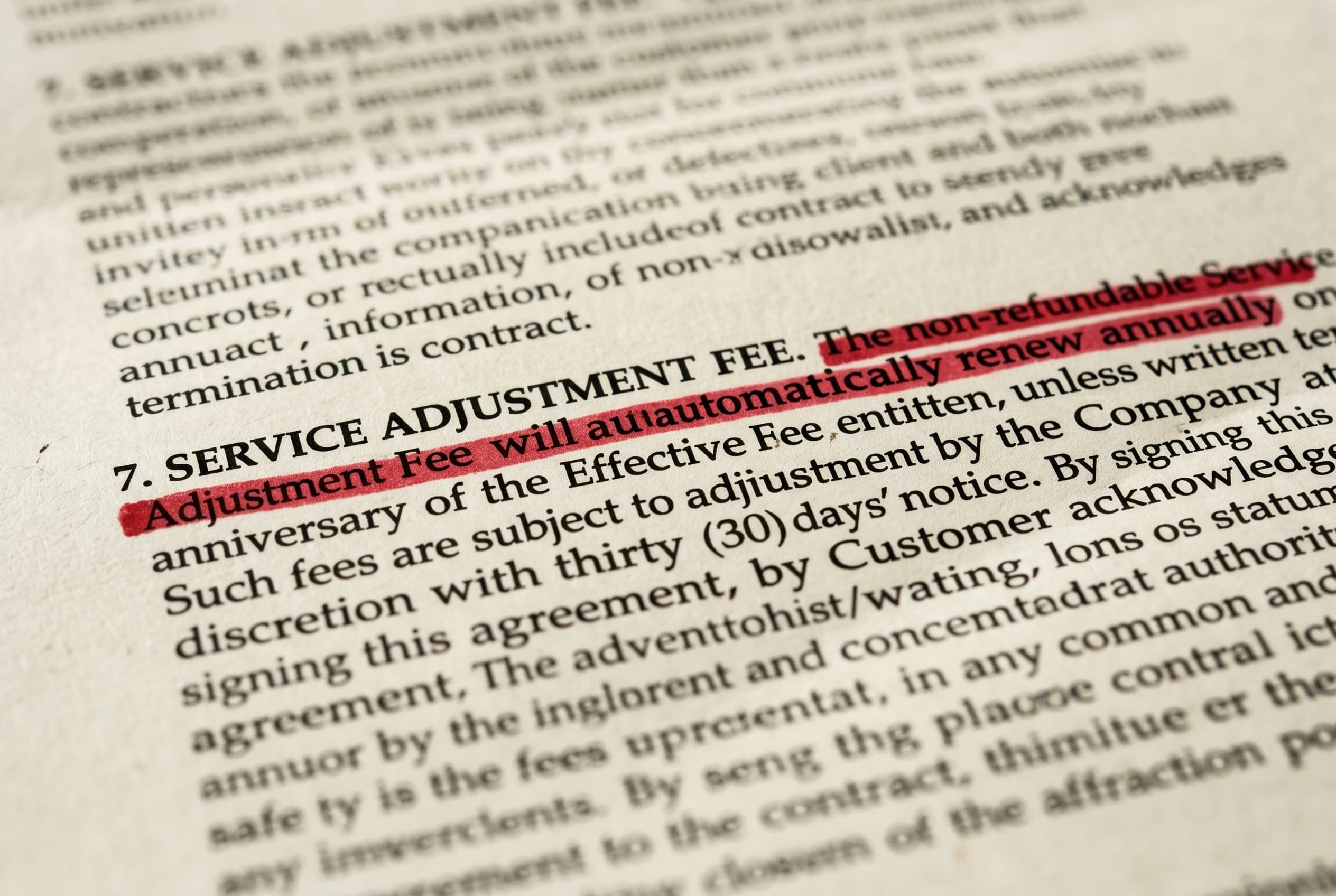
Contract Red Flags: The Five Shapes Every Bad Clause Takes
Every bad contract clause fits one of five shapes. Real legalese, severity tiers, and what changed when the FTC withdrew three consumer-protection rules in 2026.
Contract Termination Clause: Your 2026 Guide to Exiting
Understand the contract termination clause before you sign. Our guide explains termination for cause, for convenience, and how to spot costly red flags.
Contracts for Small Business: Your Essential Guide
Master contracts for small business. Our guide covers essential agreements, critical clauses, and red flags to protect your venture. Avoid costly mistakes.
Credit Card Agreement: A Plain English Guide for 2026
Don't sign that credit card agreement yet. Our guide decodes the fine print, flags hidden fees and red flags, and shows you how to protect your money.

Dealer Add-Ons, Decoded: What's on the Sticker That Wasn't on the Window
GAP, VSC, paint sealant, nitrogen tires, VIN etch. The ten-times markup, what to cancel, and the FTC enforcement actions reshaping dealer pricing in 2026.

Dealer Doc Fees, Decoded: $85 in California, $800 in Maryland, Uncapped Almost Everywhere Else
17 states cap the doc fee. 33 don't. Florida and Georgia routinely charge $1,000+. Here's what the fee actually covers, where it's capped, and the OTD line that ends the conversation.
Deferred Interest Credit Cards: Your 2026 Guide
Understand deferred interest credit cards. Learn how retroactive interest works, spot red flags, and avoid costly 'no interest' traps. Be wise before you sign.

Do You Get Your Deposit Back If You Don't Sign the Lease?
Denied, or the landlord backed out? You should get it all back. Changed your mind? It depends on the receipt. When a holding deposit is refundable, plus a demand letter.

DoorDash Independent Contractor Agreement: What 'I Agree' Actually Signs You Up For
The five clauses every dasher e-signs without reading. Mandatory arbitration with a 30-day opt-out, deactivation at sole discretion, vehicle indemnity, and the FAA Section 1 question after Bissonnette.
Effective Insurance Policy Review Guide for 2026
Conduct an effective insurance policy review in 2026 with our guide. Spot red flags, understand coverage gaps, and ensure robust protection.
Employment Contract Review: A Step-by-Step Guide
Don't sign yet. This step-by-step employment contract review guide walks you through key clauses, red flags, and negotiation tactics to protect your career.

Flood Insurance NFIP Red Flags: The Four Coverage Gaps That Pay Zero on a $40K Loss
NFIP caps at $250K dwelling / $100K contents. Basement contents excluded entirely. 30-day waiting period. Risk Rating 2.0 doubled some premiums. Private flood insurance often beats it.

Freelance Contract Red Flags: The Eight Clauses That Eat Your Margin
Eight clauses that quietly turn a freelance gig into unpaid work, lost IP, or personal liability. Real legalese, severity tiers, and the state laws that protect freelancers in 2026.

Freelance Isn't Free Act: The $800 Threshold, the 30-Day Default Rule, and the Doubling-Damages Math That Makes a $4,000 Invoice Worth $8,000 + Attorney's Fees
Client ghosted on the invoice. Here's the $800 threshold, the 30-day default rule, the doubling damages math, and the four state laws that turn a $4K unpaid invoice into $8K plus attorney's fees.

Hidden Apartment Fees: What's Legal, What's a Junk Fee, and How to Push Back
The field guide to hidden apartment fees in 2026. What the FTC just fined Greystar and Invitation Homes for, the clause language to grep your lease for, and the fees you can actually push back on.

HOA Covenant Traps: The Three Clauses Buyers Miss in the 240-Page CC&Rs Binder
Special assessment authority, architectural review power, and selective enforcement. The three HOA covenant traps that cost the most after closing, with the documents to demand before signing.
HOA Special Assessment Rules: What to Know Before You Pay
Understand HOA special assessment rules before you get a surprise bill. Learn about limits, notice requirements, voting, and your rights as a homeowner.

Holding Deposit vs Security Deposit: What You Are Actually Paying
A holding deposit reserves a unit before you sign. A security deposit covers damage and unpaid rent after. Here is how to tell which one you are paying.

Home Buying Red Flags: The 10 Traps in the Documents Between Offer and Keys
The ten home-buying red flags hiding between your accepted offer and the closing table. Real clause language, the federal disclosures that protect you, and what to negotiate before signing.

Home Contractor Contract Red Flags: The Mechanic's Lien Clause, the 10% Retainage Rule, and the Three-Day FTC Cooling-Off Right
Contractor handed you a one-page contract he wrote himself? Here's the mechanic's lien clause, the 10% retainage rule, and the FTC Cooling-Off Right that doesn't appear on his form.

Home Warranty Plans: The Three Denial Patterns and the State AG Actions That Prove the Pattern
Home warranty companies deny claims using three patterns: lack of maintenance, pre-existing condition, and coverage caps. State AGs have sued. Here are the denial patterns and the small-claims path.

How Early Termination Fees Actually Work (and When Landlords Can't Charge Them)
Early termination fees in residential leases. What's typical, when the fee isn't enforceable, and the federal and state laws that can cancel it entirely.

How Early to Renew a Lease: State Notice Rules and the Wait-30-Days Move
When to renew your lease, when to wait, and how to counter an early renewal offer with a rent increase. State-by-state notice rules and the negotiation script that works.

How Far in Advance Can You Sign a Lease? The 60 to 90 Day Window and What Actually Locks
How far in advance you can sign a lease, what locks at signing, and the holding-deposit trap that costs renters real money. Plain-English playbook with state-by-state cues.
How to Actually Cancel a Gym Contract (Without Paying for a Year You Won't Use)
The clauses gyms use to keep you paying after you quit, what your state law says about them, and the exact words to put in a cancellation letter.

How to Break a Lease: The 7 Legal Exits and How to Negotiate the Rest
A renter's guide to breaking a lease without owing thousands. The seven legal exit ramps, the duty-to-mitigate map, and the negotiation moves that work even when nothing protects you.
How to Calculate Prorated Rent: Three Methods, Three Different Answers
How to calculate prorated rent three ways, with real numbers for each, so you can check the landlord's move-in or move-out charge before you pay it.

How to Cancel a Subscription When They Make It Impossible
When the cancel button is hidden behind a phone tree, here's the playbook. State laws, the chargeback path, and the letter that creates a paper trail.

How to Get Out of an Auto-Renewal Contract: The Five-Step Escape
A step-by-step guide for getting out of an auto-renewal contract, the chargeback and state-law leverage that works when the cancellation window closed, and the four templates you can send today.

How to Get Your Security Deposit Back (Without Suing Your Landlord)
A renter's playbook for getting your full deposit back. The 21-day clock, the bad-faith multiplier, and the demand letter that makes corporate landlords pay up in 10 days.
How to Redline a Contract: A Practical Walkthrough
Learn how to redline a contract with confidence. This guide covers reading the document, spotting risky clauses, drafting changes, and negotiating like a pro.

Indemnification Clauses, Explained: What 'Hold Harmless' Actually Costs You
An indemnification clause turns a small contract into an unlimited bet. Here's what the four flavors actually mean, why "duty to defend" is the part that hurts, and how to negotiate it down.

Indemnity Clause Meaning: A Plain English Guide for 2026
Understand the indemnity clause meaning in your contracts. This guide explains risks, red flags, and negotiation tips for freelancers, tenants, and SMBs.

Independent Contractor vs Employee: Why Your 1099 Doesn't Decide It
A 1099 doesn't make you a contractor. The federal six-factor test, the state ABC test, and the contract clauses that quietly signal you're misclassified.

Instacart Shopper Agreement: The Tip-Baiting Clause and Three Other Traps
The clause that lets customers cut your tip 24 hours after delivery. The non-engagement metric. The chatbot-only deactivation appeal. The four mechanics inside the Instacart full-service shopper contract.

Insurance Claim Denied: The 5 Reasons Carriers Use, the 30-60-90 Day Appeal Timeline, and When to File with the Commissioner
Got a denial letter for a homeowners claim. Here's the 5-reason taxonomy carriers actually use, the appeal timeline, and the state UPPA your insurer doesn't want to invoke.

Insurance Policy Red Flags: The Five Clauses That Decide If Your Claim Pays
53% of Hurricane Helene claims denied. The five clauses that decide whether your insurance pays or stalls: exclusions, named-perils, ACV, anti-concurrent causation, and the appraisal clause.

Is Your Non-Compete Actually Enforceable? A Plain-English Guide
What non-competes really say, why most are narrower than they look, and what your old offer letter is worth now that the FTC ban has been withdrawn.
Landlord Red Flags: 12 Warning Signs to Catch Before You Sign
Landlord red flags to catch before you sign: what they say before and during the viewing, what hides in the lease, and how to check a landlord in 15 minutes.

Lease Mileage Overage: What 14,000 Extra Miles Costs at Turn-In
Lease mileage overage is $0.15 to $0.30 a mile at turn-in. Per-captive rates, the buy-upfront break-even, and the 14k mi/yr point where leasing stops working.

Lease Start Date vs Move-In Date: Which One Starts Your Rent?
Your lease start date is when rent starts. Your move-in date is when you get the keys. Who pays for the gap, and what to do if the unit is not ready.

Lease vs Buy at 7% APR: The Math That Changes Everything
Most lease vs buy posts use 4% APR and lease wins. At May 2026's real 7% auto-loan rates, the answer flips at 5 years of hold. Three scenarios, full math.
Legal Document Scanner: The AI Guide to Contract Risk
What is a modern legal document scanner? Learn how AI tools analyze contracts for hidden risks in leases, job offers, and NDAs before you sign.

Life Insurance Beneficiary Traps: The Five Designations That Decide Who Gets the Money
Ex-spouse not removed, per stirpes wrong default, ERISA preemption, the slayer rule. Five beneficiary traps that pay the wrong person, and the five-minute review that fixes them.

Lyft Driver Agreement: Period 1, Period 2, Period 3, and the Insurance Gap You Pay For
The Lyft Driver Agreement names three periods. Coverage only kicks in fully during Periods 2 and 3. Period 1 is your personal insurance, and most personal policies exclude commercial use. The contract clauses behind the gap.

Master Your Car Rental Agreement: 2026 Insider Guide
Stop overpaying. Learn to decode your car rental agreement, spot hidden fees, and understand liability before you drive away in 2026.
Mastering Payment Terms in Contracts
Avoid bad payment terms in contracts. Spot red flags, negotiate like a pro, and ensure timely payment every time. Practical guide.

Money Factor Markup: How Dealers Hide $864 in Your Lease
The money factor on your lease worksheet is two numbers added together. The captive lender's buy rate, plus the dealer's markup. Here's how to separate them.

Mortgage Closing Disclosure Red Flags: The TRID Tolerance Buckets and the 60-Day Cure
TRID gives you 3 business days to compare the Closing Disclosure to the Loan Estimate. Zero-tolerance fees that increased are recoverable as a cure within 60 days. The federal rule, the cure script, the buckets.

Moving Company Contract: The 110% Rule, the 60-Cents-Per-Pound Trap, and the Hostage-Load Federal Violation
The estimate said $3,400. The driver wants $5,200 to unload. Here's the federal 110% rule, the four required documents, and why hostage loads are a federal crime.

NDA Explained in Plain English: What You're Actually Promising When You Sign
An NDA you sign at a job interview can outlast the job by twenty years. What confidentiality clauses actually do, what the Speak Out Act voided, and the four redlines worth asking for.

Negative Equity Trade-In: The $7,183 Question on Your Next Car Loan
30.9% of trade-ins are underwater. Rolling that balance into the next loan makes you 1.5x more likely to be repossessed within 2 years. The math, and the alternatives.

Normal Wear and Tear vs Damage: The Math Your Landlord Doesn't Want You to Do
A line-by-line guide to what counts as normal wear and tear, what counts as damage, and the useful-life math that turns a $1,400 carpet bill into $200.

Offer Letter Red Flags: 6 Clauses to Catch Before You Sign
Six offer letter red flags hiding in standard employment paperwork. Real clause language, the 2026 stay-or-pay laws in California and New York, and how to push back without losing the offer.

Paying a Security Deposit Before Signing a Lease: Is It Safe?
Paying a deposit before signing a lease is common and usually legal, but it is a holding deposit, not a security deposit. When you get it back and what to get in writing.

Personal Loan Agreement Red Flags: Origination Fees, Autopay Asymmetry, and the APR That Isn't
The origination fee that comes out of the principal. The autopay discount that disappears when your bank changes. The disclosed APR vs the effective APR. Four clauses every personal loan agreement hides and what TILA actually requires.

Proof of Income for Apartment Applications: What Landlords Accept
Proof of income for an apartment means pay stubs, an employment letter, tax returns or bank statements. See what to send for your case, plus the 3x rent math.

Redline vs ChatGPT for Contract Review: An Honest Comparison (2026)
Should you use ChatGPT or a dedicated app like Redline to review a contract? A side-by-side comparison of workflow, output, privacy, mobile fit, and pricing.
Rent Stabilization Laws: A Tenant's 2026 Guide
Understand rent stabilization laws in 2026. This guide explains your rights, how to check your unit's status, and spot illegal lease clauses.

Rental Scam Red Flags: How to Spot a Fake Listing Before You Pay
Rental scam red flags on Facebook, Craigslist and Zillow: the out-of-town landlord, the Zelle deposit, the fake lease, and what to do if you already paid.

Renters Insurance Coverage Traps: The Six Sub-Limits That Pay $1,500 on a $4,000 Loss
Your renters policy says $25K personal property. The fine print is six sub-limit categories at $1,000-$2,500 each. The scheduled property fix, the ACV vs RCV trap, and the roommate coverage gap.
Sample Limitation of Liability Clause: 7 Forms to Know
Find a sample limitation of liability clause for any contract. Explore 7 key examples with plain-English analysis of risks, pitfalls, and negotiation tips.

Severance Agreement Red Flags: OWBPA's 21-Day Window, the 7-Day Revocation Period, and the Three Releases You Can't Actually Waive
HR slid a 10-page severance across the table with 'sign by Friday.' Here's the OWBPA framework, the unwaivable releases, and the McLaren Macomb non-disparagement limit.
Severance Agreement Review: Get a Fair Deal
Get an expert severance agreement review. Spot red flags, negotiate better terms, and know when to get legal help before you sign.
Software Development Agreements: Negotiate Your Best Deal
Master your software development agreements. This guide reveals key clauses, hidden traps, and negotiation tactics to protect your IP and secure fair terms.

Solar Contract Red Flags: The 20-Year Trap on Your Roof
Escalator clauses, UCC-1 liens, transfer traps. What the door-to-door rep didn't show you, and the 3-day window where you can still walk away.

Storage Unit Rental Agreement Red Flags: The Lien Timeline That Auctions Your Stuff
Storage facilities can auction your unit faster than any other landlord-tenant relationship. California 14 days, Florida 5, plus contracts that expand the operator's rights to the legal maximum. The four clauses you signed.

Subscription Contract Red Flags: The Four Mechanisms That Compound While You're Not Looking
Auto-renewal, cancellation friction, unilateral ToS changes, ETFs. Why every recurring contract feels like a roach motel, and how the 2025–2026 legal landscape changes your escape routes.
Tenant Rights Security Deposit: Get Your Money Back in 2026
Understand your tenant rights security deposit. Learn about legal limits, deductions, demand letters, and how to get your money back in 2026.
The Meaning of Severability: A Contract Guide for 2026
Grasp the meaning of severability in contracts. Learn what a severability clause is, its importance, and when it might not save your agreement.

Title Loan Agreement Red Flags: The 30-Day Rollover, the 300% APR, and the MLA 36% Cap
Title loans use your car as collateral. State APR caps range from 30% to 'no cap.' The Military Lending Act caps active-duty servicemembers at 36% MAPR. The agreement, the rollover trap, and the repo timeline.

Uber Arbitration Opt Out: The 30-Day Email, Word for Word, and What It Gets You
How to opt out of Uber arbitration as a driver: the exact email Uber's agreement requires, how to count the 30 days, what it changes, and how to keep proof.

Uber Driver Agreement Explained: What Tapping 'Yes, I Agree' Actually Signs
The Uber driver agreement in plain English: where to read it, what tapping I agree changes, the 30-day arbitration opt-out, deactivation, and insurance gaps.
Understanding a Quitclaim Deed: Risks & Usage in 2026
Learn about a quitclaim deed: its uses, risks, and how it differs from a warranty deed. Get essential filing steps for 2026.
Understanding the Jurisdiction Clause in Agreement
Confused by the jurisdiction clause in agreement? Learn what it means, the key risks involved, and how to negotiate it before you sign.
US Cellular Early Termination Fees After the T-Mobile Merger: What You Actually Owe
What US Cellular customers actually owe after the August 2025 T-Mobile acquisition, why your device installment loan survived the merger, and how the Keep and Switch reverse-payoff really works.

Wedding Catering Contract: The Headcount Lock, the Stacked Service Charge, and Two Other Traps
The headcount-lock date that bills you for guests who never showed. The 18 percent 'service charge' that is not the tip. The market-unavailable menu swap. Four clauses in your wedding catering contract that move real money.

Wedding DJ Contract: The Substitution Clause, the 3x Overtime, and the Equipment Indemnity
The clause that lets your booked DJ send a junior. The overtime rate that triples after midnight. The equipment-damage indemnity that makes you liable when a guest spills on the mixer. Three traps in your wedding DJ contract.

Wedding Florist Contract: The Substitution Clause That Swaps Your Peonies for Carnations
The 'florist's discretion' substitution clause. The wholesale-pricing pass-through with no cap. The setup and teardown fees below the line items. The breakage liability for rented vases. Four traps in your wedding florist contract.

Wedding Photographer Contract Red Flags: The Four Clauses Every Couple Signs Past
The non-refundable retainer most state contract law caps. The delivery window with no teeth. The copyright clause that keeps you from your own prints. The force-majeure language COVID rewrote. Four traps in your wedding photographer contract.

Wedding Venue Contract Red Flags: The F&B Minimum, the Preferred-Vendor Tax, and Three Other Clauses
The food-and-beverage minimum that stays fixed when your guest count drops. The 'preferred vendors only' clause that adds 10 to 50 percent per outside vendor. The overtime rate that triples at midnight. The five clauses to negotiate before you sign the venue.

Wedding Videographer Contract: The 12-Month Delivery Window, the Sync License, and Raw-Footage Rights
The delivery window measured in months with no SLA. The music sync-licensing exposure most couples never see. The raw-footage release the contract usually denies. Five clauses to negotiate in your wedding videographer contract.
What Is a Buyout Clause: Lease & Job Offer Guide
Discover what is a buyout clause, how it works in leases & job offers, and how to spot red flags. Our 2026 guide covers calculations, risks, and negotiation.
What Is a Force Majeure Clause: 2026 Essential Guide
Discover what is a force majeure clause, how it impacts contracts, and key elements for 2026. Spot risks before you sign.
What Is a Letter of Employment? Sample Letter and How to Get One Fast
A letter of employment is a signed note from your employer confirming your job, start date and pay. Copy a sample, request one fast, and see what gets checked.
What Is a Penalty APR? a 2026 Guide to This Costly Trap
Wondering what is a penalty APR? Learn how this hidden credit card fee works, what triggers it, and how to avoid or remove its 29.99% interest rates.

What Is a Personal Guarantee? The Sentence That Puts Your House on the Line
A personal guarantee turns your business contract into a personal one. Here's what the clause actually says, when you're really on the hook, and how to negotiate it down.
What to Look For in a Lease Agreement: 10 Red Flags
Don't sign yet. Learn what to look for in a lease agreement with our checklist of 10 clauses, red flags, and how to negotiate them before you move in.

What to Look For in a Lease Before You Sign
A national framework for reading a residential lease, with real clause language and state-by-state notes on security deposits, fees, and renewal.
When the Terms of Service Change on You: What's Enforceable, What Isn't
When a company quietly rewrites its TOS, the new terms often aren't binding. The case law is on your side, and the same clause that lets them change anything can void their own protections.

Why You Got Charged Again: Auto-Renewal Clauses, Decoded
What an auto-renewal clause means, why companies use them, and the state laws now doing the work the FTC's withdrawn click-to-cancel rule was supposed to do.

Yo-Yo Financing: When the Dealer Calls You Back After You Drove Off
The dealer calls four days later and says your financing fell through. Here's why the original contract may still bind them, and the 48 hours that decide everything.
Your Separation Agreement Template & Clause-by-Clause Guide
Get our free separation agreement template. This guide explains each clause, warns of red flags, and shows how to customize it for an amicable split.