
Insurance Policy Red Flags: The Five Clauses That Decide If Your Claim Pays
53% of Hurricane Helene claims denied. The five clauses that decide whether your insurance pays or stalls: exclusions, named-perils, ACV, anti-concurrent causation, and the appraisal clause.
8 min read

What your policy quietly excludes.
The roof is 18 years old. The hurricane took half of it. The adjuster looks at the policy, finds the line that says "Roof Surfacing Schedule Endorsement," and writes a check for $4,200 on what the contractor quoted as a $22,000 replacement.
That's not bad luck. That's the policy doing exactly what it was written to do.
Insurance policies are the most aggressive contracts most people sign without reading. The premium is the price you negotiate; the claim payout is the actual product, and it's decided entirely by clauses you almost certainly skipped. 53% of residential insurance claims after Hurricane Helene were denied. Hurricane Milton hit 39% in Florida. Wildfire claims after the January 2025 Eaton and Palisades fires are spawning a new wave of denials structured on a clause most homeowners have never heard of.
Five clauses do almost all of the deciding. Read them before you sign, fight them before the storm hits, and you'll be in a different fight than the average policyholder.
TL;DR
- Insurance is regulated almost entirely at the state level under the McCarran-Ferguson Act. There is no federal homeowners-insurance code. Your state insurance commissioner is the venue.
- Five clauses decide your claim: exclusions, named-perils vs all-risk, ACV vs replacement cost, anti-concurrent causation (ACC), and the appraisal/arbitration clause.
- Anti-concurrent causation lets the insurer deny the entire claim if any portion of the loss involves an excluded peril (often flood). Only 4 states refuse to enforce ACC: California, North Dakota, Washington, West Virginia.
- 2025–2026 trend: carriers in storm-prone regions are stripping appraisal clauses to force litigation, where they have structural advantages.
- High risk: ACV-only coverage on roof + ACC clause + percentage hurricane deductible. Medium risk: named-perils-only policy. Low risk: all-risk + RCV + appraisal preserved + low flat deductible.
The first clause: exclusions
Every policy has two halves. The covered-perils section is the marketing front. The exclusions section is the actual contract.
We do not insure for loss caused directly or indirectly by any of the
following. Such loss is excluded regardless of any other cause or
event contributing concurrently or in any sequence to the loss.
What it means: anything in the exclusion list is not covered, full stop. And the second sentence is the anti-concurrent causation language, more on that below. The standard ISO HO-3 form excludes ordinance/law, earth movement, water damage (flood), power failure, neglect, war, nuclear hazard, intentional loss, governmental action, and several others. Each exclusion has its own definitions buried elsewhere.
The trick is that exclusions interact. "Earth movement" sounds like earthquake, but it also covers post-fire mudslide, sinkhole, and even foundation settling. The post-Eaton-fire mudslides in early 2025 are being denied under earth-movement language even where the originating fire was covered.
Read the exclusions section first. If it's three pages and the perils section is one page, that ratio is the actual policy.
The second clause: named perils vs. all-risk
Two coverage frames:
Named perils. The policy lists the perils it covers, like fire, lightning, wind, hail, theft, vandalism, etc. If your loss isn't on the list, it isn't covered. Common in cheaper homeowners and most renters policies.
All-risk (open perils). The policy covers every cause of loss except those explicitly excluded. The default form for HO-3 dwelling coverage. The exclusion list is your contract.
Why it matters: under named perils, you have to prove your loss matches a listed peril. Under all-risk, the insurer has to prove your loss is excluded. The burden of proof is reversed. In a contested claim that difference is worth tens of thousands of dollars and 18 months.
If your declarations page shows HO-2 (named perils), you should know that going in. HO-3 dwelling + HO-5 contents is the standard "all-risk both sides" structure.
The third clause: ACV vs. replacement cost
The single most expensive clause to misread:
We will pay no more than the actual cash value of the damage until
actual repair or replacement is complete. If repair or replacement
is not made within 24 months from the date of loss, we will pay
only the actual cash value.
What it means: ACV (actual cash value) is the depreciated value. Replacement cost (RCV) is what it costs to replace the item with new. The gap between them is depreciation, and on roofs especially the gap is enormous.
A 5-year-old asphalt-shingle roof, original cost $22,000, on an ACV policy depreciates at roughly 5% per year. By year 5 you're looking at a $16,500 ACV value before the deductible. By year 18, the math is closer to $4,200, exactly the example in the cold open. This is the roof surfacing schedule trap, and it's been quietly added to most Florida and Texas homeowners policies in the last 10 years.
The endorsement to look for is called by various names depending on the carrier:
- Roof Surfacing Schedule is the most common name
- Roof Coverage Endorsement is the Citizens (FL) variant
- Cosmetic Damage Exclusion is increasingly attached to ACV-roof policies as well
If you have an ACV roof, find the schedule. Find the deductible. Run the math against your roof's age. If the math says you'd net less than the deductible after a total loss, the roof is functionally uninsured.

The fourth clause: anti-concurrent causation
This is the disaster killer.
We do not insure for loss caused directly or indirectly by any of
the excluded perils, regardless of any other cause or event
contributing concurrently or in any sequence to the loss.
What it means: if the loss involves both a covered peril (wind) and an excluded peril (flood), and the two combined to cause the damage, the insurer can deny the entire claim. Not the flood portion. The whole thing.
Hurricane storm surge is the canonical case. Wind blows the roof off, which is covered. Water from storm surge then ruins the floors and drywall, which is excluded as flood, even if you carry a separate flood policy. Anti-concurrent causation says: because both contributed, the whole claim is denied.
Hurricane Helene's 53% denial rate, and Milton's 39%, are heavily ACC-driven. Carriers point to flood as the contributing peril and deny everything.
The 4-state ACC carve-outs. Four states refuse to enforce ACC clauses by statute or common law:
- California
- North Dakota
- Washington
- West Virginia
In those four states, the insurer has to apportion the loss between covered and excluded perils and pay the covered portion. Everywhere else, an ACC clause in the policy ends the claim. Read your declarations carefully if you're in a hurricane or flood zone, and price separate flood coverage knowing the homeowners side likely won't help if a flood is in the picture.
The fifth clause: appraisal and arbitration
Buried at the back of every policy:
If you and we fail to agree on the amount of loss, either may
demand an appraisal of the loss. In this event, each party will
choose a competent and impartial appraiser within 20 days after
receiving a written request from the other. The two appraisers
will choose an umpire.
What it means: appraisal is a faster, cheaper alternative to litigation when the dispute is about how much the loss is worth, not whether it's covered. Each side picks an appraiser, the two pick an umpire, and the umpire's decision is binding.
For decades, appraisal clauses were one of the most consumer-friendly provisions in standard policies. They gave you a path that wasn't a lawsuit.
The 2026 problem: carriers in hurricane and wildfire-prone states are stripping or restricting appraisal clauses specifically to force claimants into litigation, where carriers have structural advantages: paid attorneys, document discovery, and time. Several Florida and Texas carriers eliminated appraisal entirely from new 2025 and 2026 issues. Some replaced it with mandatory arbitration before a single, carrier-influenced arbitrator.
If your policy lacks an appraisal clause, or has a binding-arbitration clause, that absence is a flag at signing time. The mechanic is similar to the hidden-default pattern in contract red flags. The most consumer-protective clause is the one quietly removed.
State enforcement: who actually fights insurers
Insurance is regulated by states under the McCarran-Ferguson Act (15 U.S.C. § 1011). There is no federal homeowners-insurance regulator. The active enforcers:
- California Department of Insurance. Commissioner Lara's January 2025 wildfire-resilience package added new consumer protections, including a moratorium on non-renewals in declared-disaster areas.
- New York Department of Financial Services (DFS). Aggressive on bad-faith claim handling.
- Texas Department of Insurance (TDI). Slower but has settled large class actions on roof-schedule endorsements.
- Florida Office of Insurance Regulation. Currently the most-litigated state market. Several major carriers (Allstate, State Farm, Progressive) made partial exits in 2024–2025.
If a claim is being slow-walked, the state insurance commissioner is your first stop, before lawyering up. Most commissioners have an online complaint form that gets routed to a designated examiner. The complaint goes on the carrier's record.
What to actually do before signing
Run this checklist on any policy declaration page:
- HO form. HO-3 (all-risk dwelling, named-perils contents) is standard; HO-5 (all-risk both) is better; HO-2 (named perils both) is weaker.
- Roof coverage. RCV, ACV, or scheduled? If ACV or scheduled, find the schedule and run age math. The ACV vs replacement cost calculator does the depreciation breakdown line by line for the roof, HVAC, or contents.
- Hurricane / wind deductible. Flat dollar or percentage? A 2% deductible on a $400K dwelling = $8,000 out of pocket before anything pays.
- ACC clause. Almost always present. Note state. CA, ND, WA, WV give you a fight.
- Appraisal clause. Is it there? Is it neutral? Or replaced with arbitration?
The same compounding pattern shows up in vendor payment terms and in apartment lease fees. The headline rate is the marketing, the back-section clauses are the actual contract. Insurance just makes the gap measurable in tens of thousands at the time of loss.
The shape underneath
A homeowners policy is the most aggressively asymmetric contract most people will ever sign. The premium is the only number you negotiate. The exclusions, the ACC clause, the roof schedule, the appraisal language: these are the actual product, and they were drafted by the carrier's attorneys with full knowledge of the state code that limits them. Reading the policy review checklist is the surface-level discipline. Reading the five clauses above is the structural one.
The 53% Helene denial rate is not a freak event. It is the policy doing exactly what its language permits. Knowing the language before the storm hits is the only consumer-side leverage that exists.
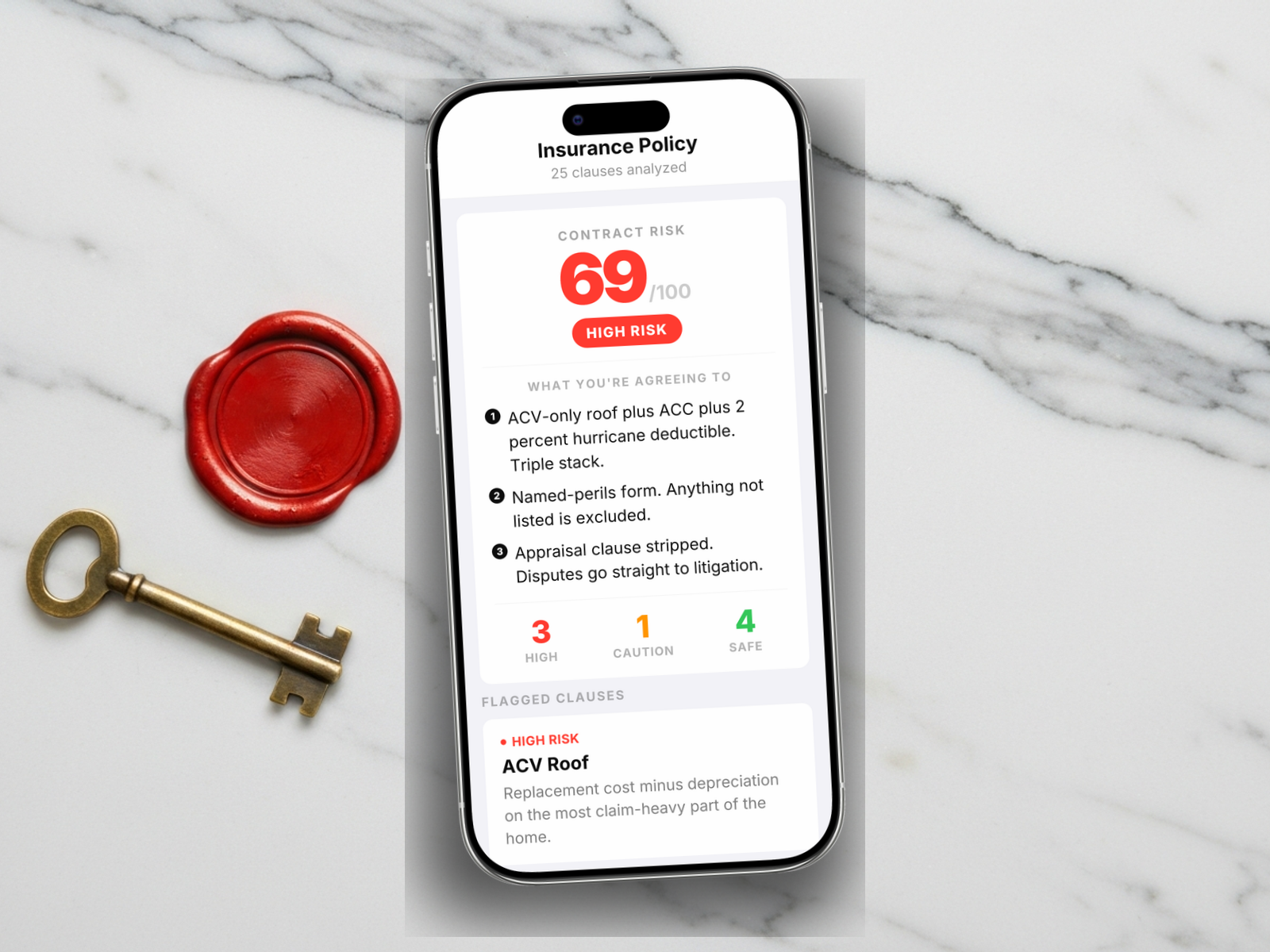
Redline reads insurance policies in plain English. Photograph the declarations page, paste in the exclusions section, or upload the endorsements packet, and Redline flags the five clauses, the deductible math, the ACC language, and any appraisal-clause stripping in seconds. One scan, one dollar. Available on iOS and Android.
Keep reading
10 Contract Negotiation Strategies for 2026
Master contract negotiation strategies for 2026. Learn to prioritize terms, frame asks, and spot risks in leases, job offers, and more with these 10 tips.

84-Month Auto Loan: The 7-Year Math the Dealer Doesn't Want You to See
22.9% of new-car loans now run 84 months. The interest cost, the negative-equity timeline, and the three scenarios where a 7-year loan actually pencils out.
A Guide to Your Remote Worker Agreement
Draft, review, and negotiate a remote worker agreement with confidence. Our guide covers key clauses, tax issues, red flags, and how to spot hidden risks.

ACV vs Replacement Cost: The Depreciation Math, the 24-Month Rule, and the Roof-Schedule Trap That Pays $4,200 on a $22,000 Roof
Roof claim came in at 25% of the quote? Here's the ACV vs replacement cost math, the 24-month rebuild rule, and the roof-schedule endorsement that quietly cuts your payout.
AI Contract Review: Your Secret Weapon Against Bad Deals
Learn how AI contract review works, what risks to watch for, and how to use it to spot unfair clauses in leases, job offers, and more. A guide for 2026.

Amazon Flex Contractor Terms: Block Forfeiture, Cargo Indemnity, and the $61.7M Tip-Skim
The block-forfeiture clause that docks pay for one missed block. The cargo indemnity that survives Amazon's app routing errors. The FTC v. Amazon Flex tip-skim settlement and what is still in the contract.

Anti-Concurrent Causation: The Insurance Clause That Denies Hurricane Wind Claims for Flood Reasons, and the 4 States That Refuse to Enforce It
Hurricane wind blew off the roof. The carrier denied the whole claim citing flood. Here's the anti-concurrent causation clause, the 4-state carve-out, and the Helene/Milton denial pattern.
Arbitration Clause Meaning: Know Your Rights
Understand the arbitration clause meaning before you sign. Learn your rights, spot risky terms, and negotiate contract changes effectively.

As-Is Used Car Sale: What 'No Warranty' Actually Lets the Dealer Get Away With
The Buyers Guide on the window has two versions. The one with 'AS IS — NO WARRANTY' checked still doesn't do what most dealers say it does. The state list, the federal floor, and the 90-day rule.

Auto Insurance Contract Red Flags: The Five Lines That Decide Whether You Walk Away Whole
The state minimum is a five-minute conversation, not real coverage. Stacked vs unstacked UM, diminished value, limited tort, and the comparative-fault math that decides what you actually recover.

Auto Loan Contract Red Flags: The Seven Shapes
Seven patterns in every auto loan contract: APR disclosures, F&I add-ons, trade-in math, arbitration, repossession, and the federal shield most buyers don't know.

Best AI Contract Review Apps in 2026: An Honest Comparison
A side-by-side look at the consumer AI contract review apps in 2026. Redline, Justee, Contract Crab, DocuSign Iris. Pricing, what each does well, what it skips.

Buyer's Agent Agreement Post-NAR Settlement: The Four Lines That Are Now Negotiable
Post-NAR settlement, the buyer-broker agreement is now required and now negotiable. The four lines to fight: compensation rate, exclusivity term, property scope, and the seller-pays gap.

Cap Cost Reduction on a Lease: When $3,000 Down Disappears
The $3,000 due at signing on a lease ad is mostly cap cost reduction. Here is what it actually buys, when it vanishes, and the handful of states where it can pay for itself.

Car Lease Red Flags: 5 Tricks Dealers Use to Pad Your Monthly Payment
Five car lease tricks that quietly add thousands to your monthly payment. Real F&I clause language, the federal disclosures that don't apply, and how to push back.

CareCredit Deferred Interest: The Retroactive 26.99% APR Most Cardholders Don't See Coming
CareCredit's deferred interest is not 0%. It is 0% only if you pay the entire balance by the promotional end date. Miss it by a day and the full balance gets billed back at 26.99% from the original purchase date. The CFPB $34.1M action, the math, and the fix.

Cell Phone Early Termination Fees, Decoded: What You Actually Owe
What carriers really charge to leave early, why your device installment loan is the new ETF, and how to switch carriers without paying twice.
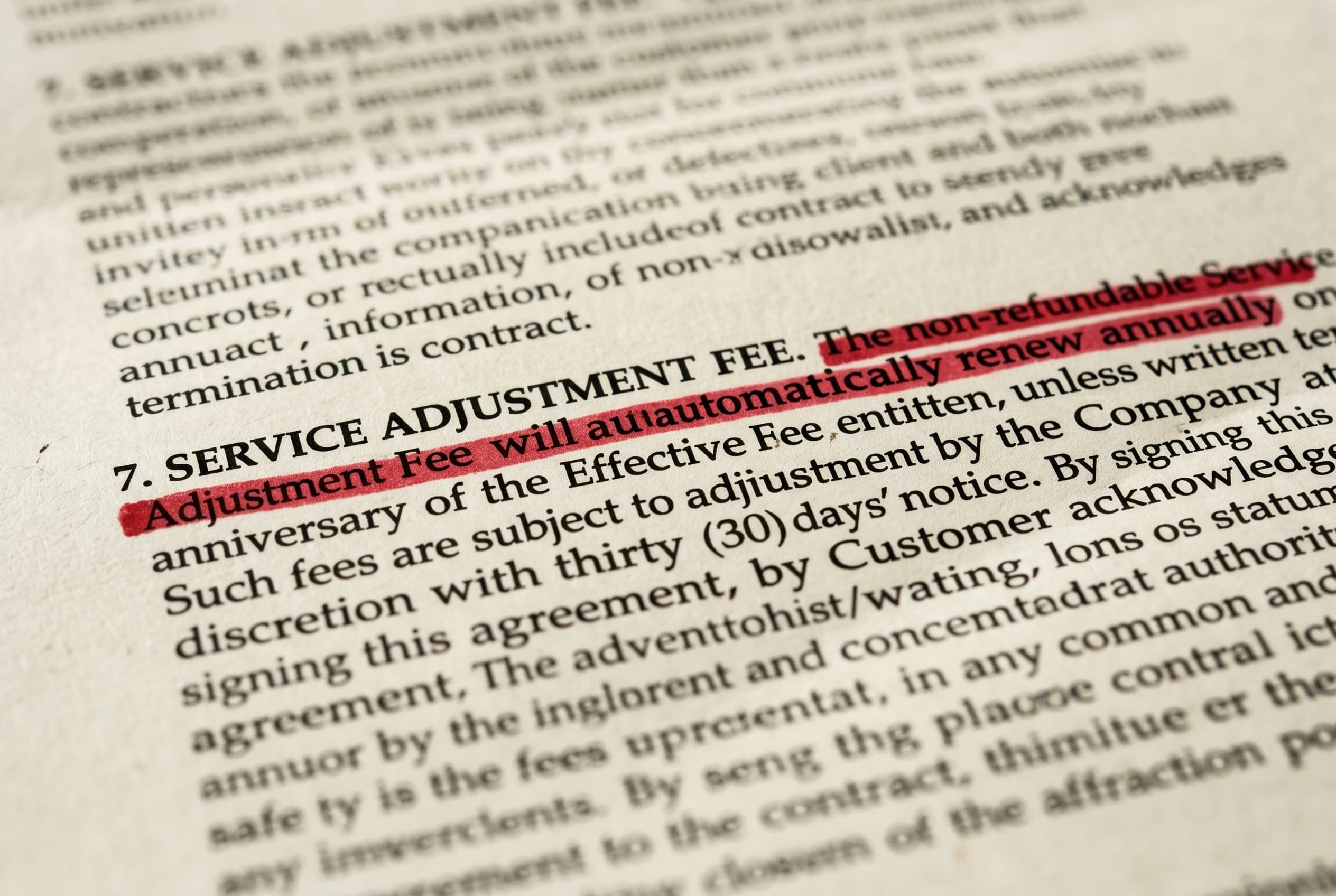
Contract Red Flags: The Five Shapes Every Bad Clause Takes
Every bad contract clause fits one of five shapes. Real legalese, severity tiers, and what changed when the FTC withdrew three consumer-protection rules in 2026.
Contract Termination Clause: Your 2026 Guide to Exiting
Understand the contract termination clause before you sign. Our guide explains termination for cause, for convenience, and how to spot costly red flags.
Contracts for Small Business: Your Essential Guide
Master contracts for small business. Our guide covers essential agreements, critical clauses, and red flags to protect your venture. Avoid costly mistakes.
Credit Card Agreement: A Plain English Guide for 2026
Don't sign that credit card agreement yet. Our guide decodes the fine print, flags hidden fees and red flags, and shows you how to protect your money.

Dealer Add-Ons, Decoded: What's on the Sticker That Wasn't on the Window
GAP, VSC, paint sealant, nitrogen tires, VIN etch. The ten-times markup, what to cancel, and the FTC enforcement actions reshaping dealer pricing in 2026.

Dealer Doc Fees, Decoded: $85 in California, $800 in Maryland, Uncapped Almost Everywhere Else
17 states cap the doc fee. 33 don't. Florida and Georgia routinely charge $1,000+. Here's what the fee actually covers, where it's capped, and the OTD line that ends the conversation.
Deferred Interest Credit Cards: Your 2026 Guide
Understand deferred interest credit cards. Learn how retroactive interest works, spot red flags, and avoid costly 'no interest' traps. Be wise before you sign.

Do You Get Your Deposit Back If You Don't Sign the Lease?
Denied, or the landlord backed out? You should get it all back. Changed your mind? It depends on the receipt. When a holding deposit is refundable, plus a demand letter.

DoorDash Independent Contractor Agreement: What 'I Agree' Actually Signs You Up For
The five clauses every dasher e-signs without reading. Mandatory arbitration with a 30-day opt-out, deactivation at sole discretion, vehicle indemnity, and the FAA Section 1 question after Bissonnette.
Effective Insurance Policy Review Guide for 2026
Conduct an effective insurance policy review in 2026 with our guide. Spot red flags, understand coverage gaps, and ensure robust protection.
Employment Contract Review: A Step-by-Step Guide
Don't sign yet. This step-by-step employment contract review guide walks you through key clauses, red flags, and negotiation tactics to protect your career.

Flood Insurance NFIP Red Flags: The Four Coverage Gaps That Pay Zero on a $40K Loss
NFIP caps at $250K dwelling / $100K contents. Basement contents excluded entirely. 30-day waiting period. Risk Rating 2.0 doubled some premiums. Private flood insurance often beats it.

Freelance Contract Red Flags: The Eight Clauses That Eat Your Margin
Eight clauses that quietly turn a freelance gig into unpaid work, lost IP, or personal liability. Real legalese, severity tiers, and the state laws that protect freelancers in 2026.

Freelance Isn't Free Act: The $800 Threshold, the 30-Day Default Rule, and the Doubling-Damages Math That Makes a $4,000 Invoice Worth $8,000 + Attorney's Fees
Client ghosted on the invoice. Here's the $800 threshold, the 30-day default rule, the doubling damages math, and the four state laws that turn a $4K unpaid invoice into $8K plus attorney's fees.

Hidden Apartment Fees: What's Legal, What's a Junk Fee, and How to Push Back
The field guide to hidden apartment fees in 2026. What the FTC just fined Greystar and Invitation Homes for, the clause language to grep your lease for, and the fees you can actually push back on.

HOA Covenant Traps: The Three Clauses Buyers Miss in the 240-Page CC&Rs Binder
Special assessment authority, architectural review power, and selective enforcement. The three HOA covenant traps that cost the most after closing, with the documents to demand before signing.
HOA Special Assessment Rules: What to Know Before You Pay
Understand HOA special assessment rules before you get a surprise bill. Learn about limits, notice requirements, voting, and your rights as a homeowner.
Holding Deposit vs Security Deposit: What You Are Actually Paying
A holding deposit reserves a unit before you sign. A security deposit covers damage and unpaid rent after. Here is how to tell which one you are paying.

Home Buying Red Flags: The 10 Traps in the Documents Between Offer and Keys
The ten home-buying red flags hiding between your accepted offer and the closing table. Real clause language, the federal disclosures that protect you, and what to negotiate before signing.

Home Contractor Contract Red Flags: The Mechanic's Lien Clause, the 10% Retainage Rule, and the Three-Day FTC Cooling-Off Right
Contractor handed you a one-page contract he wrote himself? Here's the mechanic's lien clause, the 10% retainage rule, and the FTC Cooling-Off Right that doesn't appear on his form.

Home Warranty Plans: The Three Denial Patterns and the State AG Actions That Prove the Pattern
Home warranty companies deny claims using three patterns: lack of maintenance, pre-existing condition, and coverage caps. State AGs have sued. Here are the denial patterns and the small-claims path.

How Early Termination Fees Actually Work (and When Landlords Can't Charge Them)
Early termination fees in residential leases. What's typical, when the fee isn't enforceable, and the federal and state laws that can cancel it entirely.

How Early to Renew a Lease: State Notice Rules and the Wait-30-Days Move
When to renew your lease, when to wait, and how to counter an early renewal offer with a rent increase. State-by-state notice rules and the negotiation script that works.

How Far in Advance Can You Sign a Lease? The 60 to 90 Day Window and What Actually Locks
How far in advance you can sign a lease, what locks at signing, and the holding-deposit trap that costs renters real money. Plain-English playbook with state-by-state cues.
How to Actually Cancel a Gym Contract (Without Paying for a Year You Won't Use)
The clauses gyms use to keep you paying after you quit, what your state law says about them, and the exact words to put in a cancellation letter.

How to Break a Lease: The 7 Legal Exits and How to Negotiate the Rest
A renter's guide to breaking a lease without owing thousands. The seven legal exit ramps, the duty-to-mitigate map, and the negotiation moves that work even when nothing protects you.
How to Calculate Prorated Rent: Three Methods, Three Different Answers
How to calculate prorated rent three ways, with real numbers for each, so you can check the landlord's move-in or move-out charge before you pay it.

How to Cancel a Subscription When They Make It Impossible
When the cancel button is hidden behind a phone tree, here's the playbook. State laws, the chargeback path, and the letter that creates a paper trail.

How to Get Out of an Auto-Renewal Contract: The Five-Step Escape
A step-by-step guide for getting out of an auto-renewal contract, the chargeback and state-law leverage that works when the cancellation window closed, and the four templates you can send today.

How to Get Your Security Deposit Back (Without Suing Your Landlord)
A renter's playbook for getting your full deposit back. The 21-day clock, the bad-faith multiplier, and the demand letter that makes corporate landlords pay up in 10 days.
How to Redline a Contract: A Practical Walkthrough
Learn how to redline a contract with confidence. This guide covers reading the document, spotting risky clauses, drafting changes, and negotiating like a pro.

Indemnification Clauses, Explained: What 'Hold Harmless' Actually Costs You
An indemnification clause turns a small contract into an unlimited bet. Here's what the four flavors actually mean, why "duty to defend" is the part that hurts, and how to negotiate it down.
Indemnity Clause Meaning: A Plain English Guide for 2026
Understand the indemnity clause meaning in your contracts. This guide explains risks, red flags, and negotiation tips for freelancers, tenants, and SMBs.

Independent Contractor vs Employee: Why Your 1099 Doesn't Decide It
A 1099 doesn't make you a contractor. The federal six-factor test, the state ABC test, and the contract clauses that quietly signal you're misclassified.

Instacart Shopper Agreement: The Tip-Baiting Clause and Three Other Traps
The clause that lets customers cut your tip 24 hours after delivery. The non-engagement metric. The chatbot-only deactivation appeal. The four mechanics inside the Instacart full-service shopper contract.

Insurance Claim Denied: The 5 Reasons Carriers Use, the 30-60-90 Day Appeal Timeline, and When to File with the Commissioner
Got a denial letter for a homeowners claim. Here's the 5-reason taxonomy carriers actually use, the appeal timeline, and the state UPPA your insurer doesn't want to invoke.

Is Your Non-Compete Actually Enforceable? A Plain-English Guide
What non-competes really say, why most are narrower than they look, and what your old offer letter is worth now that the FTC ban has been withdrawn.
Landlord Red Flags: 12 Warning Signs to Catch Before You Sign
Landlord red flags to catch before you sign: what they say before and during the viewing, what hides in the lease, and how to check a landlord in 15 minutes.
Lease Mileage Overage: What 14,000 Extra Miles Costs at Turn-In
Lease mileage overage is $0.15 to $0.30 a mile at turn-in. Per-captive rates, the buy-upfront break-even, and the 14k mi/yr point where leasing stops working.

Lease Start Date vs Move-In Date: Which One Starts Your Rent?
Your lease start date is when rent starts. Your move-in date is when you get the keys. Who pays for the gap, and what to do if the unit is not ready.

Lease vs Buy at 7% APR: The Math That Changes Everything
Most lease vs buy posts use 4% APR and lease wins. At May 2026's real 7% auto-loan rates, the answer flips at 5 years of hold. Three scenarios, full math.
Legal Document Scanner: The AI Guide to Contract Risk
What is a modern legal document scanner? Learn how AI tools analyze contracts for hidden risks in leases, job offers, and NDAs before you sign.

Life Insurance Beneficiary Traps: The Five Designations That Decide Who Gets the Money
Ex-spouse not removed, per stirpes wrong default, ERISA preemption, the slayer rule. Five beneficiary traps that pay the wrong person, and the five-minute review that fixes them.

Lyft Driver Agreement: Period 1, Period 2, Period 3, and the Insurance Gap You Pay For
The Lyft Driver Agreement names three periods. Coverage only kicks in fully during Periods 2 and 3. Period 1 is your personal insurance, and most personal policies exclude commercial use. The contract clauses behind the gap.

Master Your Car Rental Agreement: 2026 Insider Guide
Stop overpaying. Learn to decode your car rental agreement, spot hidden fees, and understand liability before you drive away in 2026.
Mastering Payment Terms in Contracts
Avoid bad payment terms in contracts. Spot red flags, negotiate like a pro, and ensure timely payment every time. Practical guide.

Money Factor Markup: How Dealers Hide $864 in Your Lease
The money factor on your lease worksheet is two numbers added together. The captive lender's buy rate, plus the dealer's markup. Here's how to separate them.

Mortgage Closing Disclosure Red Flags: The TRID Tolerance Buckets and the 60-Day Cure
TRID gives you 3 business days to compare the Closing Disclosure to the Loan Estimate. Zero-tolerance fees that increased are recoverable as a cure within 60 days. The federal rule, the cure script, the buckets.

Moving Company Contract: The 110% Rule, the 60-Cents-Per-Pound Trap, and the Hostage-Load Federal Violation
The estimate said $3,400. The driver wants $5,200 to unload. Here's the federal 110% rule, the four required documents, and why hostage loads are a federal crime.

NDA Explained in Plain English: What You're Actually Promising When You Sign
An NDA you sign at a job interview can outlast the job by twenty years. What confidentiality clauses actually do, what the Speak Out Act voided, and the four redlines worth asking for.

Negative Equity Trade-In: The $7,183 Question on Your Next Car Loan
30.9% of trade-ins are underwater. Rolling that balance into the next loan makes you 1.5x more likely to be repossessed within 2 years. The math, and the alternatives.

Normal Wear and Tear vs Damage: The Math Your Landlord Doesn't Want You to Do
A line-by-line guide to what counts as normal wear and tear, what counts as damage, and the useful-life math that turns a $1,400 carpet bill into $200.

Offer Letter Red Flags: 6 Clauses to Catch Before You Sign
Six offer letter red flags hiding in standard employment paperwork. Real clause language, the 2026 stay-or-pay laws in California and New York, and how to push back without losing the offer.

Paying a Security Deposit Before Signing a Lease: Is It Safe?
Paying a deposit before signing a lease is common and usually legal, but it is a holding deposit, not a security deposit. When you get it back and what to get in writing.

Personal Loan Agreement Red Flags: Origination Fees, Autopay Asymmetry, and the APR That Isn't
The origination fee that comes out of the principal. The autopay discount that disappears when your bank changes. The disclosed APR vs the effective APR. Four clauses every personal loan agreement hides and what TILA actually requires.

Proof of Income for Apartment Applications: What Landlords Accept
Proof of income for an apartment means pay stubs, an employment letter, tax returns or bank statements. See what to send for your case, plus the 3x rent math.
Redline vs ChatGPT for Contract Review: An Honest Comparison (2026)
Should you use ChatGPT or a dedicated app like Redline to review a contract? A side-by-side comparison of workflow, output, privacy, mobile fit, and pricing.
Rent Stabilization Laws: A Tenant's 2026 Guide
Understand rent stabilization laws in 2026. This guide explains your rights, how to check your unit's status, and spot illegal lease clauses.

Rental Scam Red Flags: How to Spot a Fake Listing Before You Pay
Rental scam red flags on Facebook, Craigslist and Zillow: the out-of-town landlord, the Zelle deposit, the fake lease, and what to do if you already paid.

Renters Insurance Coverage Traps: The Six Sub-Limits That Pay $1,500 on a $4,000 Loss
Your renters policy says $25K personal property. The fine print is six sub-limit categories at $1,000-$2,500 each. The scheduled property fix, the ACV vs RCV trap, and the roommate coverage gap.
Sample Limitation of Liability Clause: 7 Forms to Know
Find a sample limitation of liability clause for any contract. Explore 7 key examples with plain-English analysis of risks, pitfalls, and negotiation tips.

Severance Agreement Red Flags: OWBPA's 21-Day Window, the 7-Day Revocation Period, and the Three Releases You Can't Actually Waive
HR slid a 10-page severance across the table with 'sign by Friday.' Here's the OWBPA framework, the unwaivable releases, and the McLaren Macomb non-disparagement limit.
Severance Agreement Review: Get a Fair Deal
Get an expert severance agreement review. Spot red flags, negotiate better terms, and know when to get legal help before you sign.
Software Development Agreements: Negotiate Your Best Deal
Master your software development agreements. This guide reveals key clauses, hidden traps, and negotiation tactics to protect your IP and secure fair terms.

Solar Contract Red Flags: The 20-Year Trap on Your Roof
Escalator clauses, UCC-1 liens, transfer traps. What the door-to-door rep didn't show you, and the 3-day window where you can still walk away.

Storage Unit Rental Agreement Red Flags: The Lien Timeline That Auctions Your Stuff
Storage facilities can auction your unit faster than any other landlord-tenant relationship. California 14 days, Florida 5, plus contracts that expand the operator's rights to the legal maximum. The four clauses you signed.

Subscription Contract Red Flags: The Four Mechanisms That Compound While You're Not Looking
Auto-renewal, cancellation friction, unilateral ToS changes, ETFs. Why every recurring contract feels like a roach motel, and how the 2025–2026 legal landscape changes your escape routes.
Tenant Rights Security Deposit: Get Your Money Back in 2026
Understand your tenant rights security deposit. Learn about legal limits, deductions, demand letters, and how to get your money back in 2026.
The 8-Point Contract Review Checklist
Use this 8-point contract review checklist to spot red flags in liability, IP, termination, and payment clauses before you sign. For freelancers & tenants.
The Meaning of Severability: A Contract Guide for 2026
Grasp the meaning of severability in contracts. Learn what a severability clause is, its importance, and when it might not save your agreement.

Title Loan Agreement Red Flags: The 30-Day Rollover, the 300% APR, and the MLA 36% Cap
Title loans use your car as collateral. State APR caps range from 30% to 'no cap.' The Military Lending Act caps active-duty servicemembers at 36% MAPR. The agreement, the rollover trap, and the repo timeline.

Uber Arbitration Opt Out: The 30-Day Email, Word for Word, and What It Gets You
How to opt out of Uber arbitration as a driver: the exact email Uber's agreement requires, how to count the 30 days, what it changes, and how to keep proof.

Uber Driver Agreement Explained: What Tapping 'Yes, I Agree' Actually Signs
The Uber driver agreement in plain English: where to read it, what tapping I agree changes, the 30-day arbitration opt-out, deactivation, and insurance gaps.
Understanding a Quitclaim Deed: Risks & Usage in 2026
Learn about a quitclaim deed: its uses, risks, and how it differs from a warranty deed. Get essential filing steps for 2026.
Understanding the Jurisdiction Clause in Agreement
Confused by the jurisdiction clause in agreement? Learn what it means, the key risks involved, and how to negotiate it before you sign.
US Cellular Early Termination Fees After the T-Mobile Merger: What You Actually Owe
What US Cellular customers actually owe after the August 2025 T-Mobile acquisition, why your device installment loan survived the merger, and how the Keep and Switch reverse-payoff really works.
Wedding Catering Contract: The Headcount Lock, the Stacked Service Charge, and Two Other Traps
The headcount-lock date that bills you for guests who never showed. The 18 percent 'service charge' that is not the tip. The market-unavailable menu swap. Four clauses in your wedding catering contract that move real money.

Wedding DJ Contract: The Substitution Clause, the 3x Overtime, and the Equipment Indemnity
The clause that lets your booked DJ send a junior. The overtime rate that triples after midnight. The equipment-damage indemnity that makes you liable when a guest spills on the mixer. Three traps in your wedding DJ contract.

Wedding Florist Contract: The Substitution Clause That Swaps Your Peonies for Carnations
The 'florist's discretion' substitution clause. The wholesale-pricing pass-through with no cap. The setup and teardown fees below the line items. The breakage liability for rented vases. Four traps in your wedding florist contract.

Wedding Photographer Contract Red Flags: The Four Clauses Every Couple Signs Past
The non-refundable retainer most state contract law caps. The delivery window with no teeth. The copyright clause that keeps you from your own prints. The force-majeure language COVID rewrote. Four traps in your wedding photographer contract.

Wedding Venue Contract Red Flags: The F&B Minimum, the Preferred-Vendor Tax, and Three Other Clauses
The food-and-beverage minimum that stays fixed when your guest count drops. The 'preferred vendors only' clause that adds 10 to 50 percent per outside vendor. The overtime rate that triples at midnight. The five clauses to negotiate before you sign the venue.

Wedding Videographer Contract: The 12-Month Delivery Window, the Sync License, and Raw-Footage Rights
The delivery window measured in months with no SLA. The music sync-licensing exposure most couples never see. The raw-footage release the contract usually denies. Five clauses to negotiate in your wedding videographer contract.
What Is a Buyout Clause: Lease & Job Offer Guide
Discover what is a buyout clause, how it works in leases & job offers, and how to spot red flags. Our 2026 guide covers calculations, risks, and negotiation.
What Is a Force Majeure Clause: 2026 Essential Guide
Discover what is a force majeure clause, how it impacts contracts, and key elements for 2026. Spot risks before you sign.
What Is a Letter of Employment? Sample Letter and How to Get One Fast
A letter of employment is a signed note from your employer confirming your job, start date and pay. Copy a sample, request one fast, and see what gets checked.
What Is a Penalty APR? a 2026 Guide to This Costly Trap
Wondering what is a penalty APR? Learn how this hidden credit card fee works, what triggers it, and how to avoid or remove its 29.99% interest rates.

What Is a Personal Guarantee? The Sentence That Puts Your House on the Line
A personal guarantee turns your business contract into a personal one. Here's what the clause actually says, when you're really on the hook, and how to negotiate it down.
What to Look For in a Lease Agreement: 10 Red Flags
Don't sign yet. Learn what to look for in a lease agreement with our checklist of 10 clauses, red flags, and how to negotiate them before you move in.

What to Look For in a Lease Before You Sign
A national framework for reading a residential lease, with real clause language and state-by-state notes on security deposits, fees, and renewal.
When the Terms of Service Change on You: What's Enforceable, What Isn't
When a company quietly rewrites its TOS, the new terms often aren't binding. The case law is on your side, and the same clause that lets them change anything can void their own protections.

Why You Got Charged Again: Auto-Renewal Clauses, Decoded
What an auto-renewal clause means, why companies use them, and the state laws now doing the work the FTC's withdrawn click-to-cancel rule was supposed to do.

Yo-Yo Financing: When the Dealer Calls You Back After You Drove Off
The dealer calls four days later and says your financing fell through. Here's why the original contract may still bind them, and the 48 hours that decide everything.
Your Separation Agreement Template & Clause-by-Clause Guide
Get our free separation agreement template. This guide explains each clause, warns of red flags, and shows how to customize it for an amicable split.